
By David Bennett
 Before I get into the actual story, let me provide some back ground information on two people that helps make this story even more interesting. One helped to make the account famous by writing about it and the other was a well-known female Chicago police detective who solved the crime of the murder of a young lady, Eileen Perry (sometimes reported as Ellen Perry). Given that 110 years that have passed since the murder occurred this background material helps to put the story in perspective of the time.
The reporter, Courtney Ryley Cooper (1886–1940), was a former circus performer, publicist and writer. He worked as a newspaper reporter for The Kansas City Star, New York World, the Chicago Tribune and the Denver Post. During his career he published over 30 books, many focusing on crime. FBI Director J. Edgar Hoover once considered him, “the best informed man on crime in the U. S.” and allowed Cooper access to FBI case files.
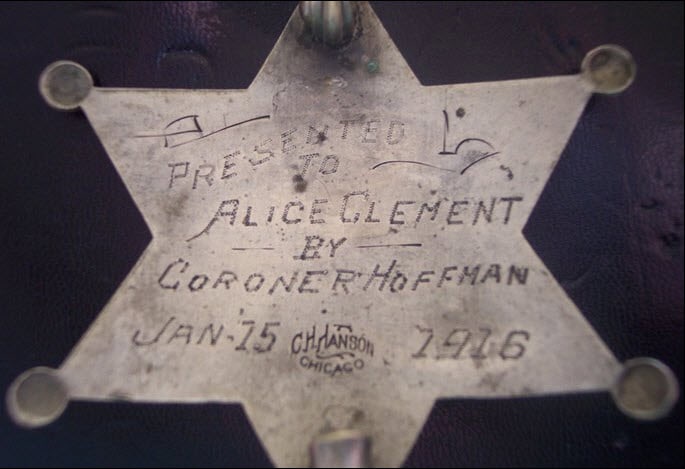
In 1913 Cooper wrote a 12-part serial, The Cases of Alice Clement: True Stories of the World’s Greatest Woman Sleuth as Told by Herself to Courtney Riley Cooper. In the first serial installment in March of 1913 the Editor’s Note said in part: “On the payroll of the municipal detective department of the city of Chicago appears the name of Alice Clement, sleuth… Fearless, resourceful, dangerous in a hundred simple little disguises which mask… she has found the evidence which has sent many a man and many a woman to the penitentiary. There is hardly a dangerous dive of the great city which she in her twelve years of detective life, has not visited. More than once has her life been in danger, many times has she been compelled to use the dirk or the revolver that she carries for protection. And yet, through it all, she has remained pretty, vivacious, full of life and the love of living — and always deserving of her name, “Alice of the Smile.” Too, she has always remained reticent, non-communicative about her adventures, until Mr. Cooper persuaded her to tell her adventures for the first time.” The last of Cooper’s serials was, “The Dulcimer.”
The detective, Alice Clement (1878–1926), was born Alice Bush in Milwaukee, Wisconsin and died in Chicago, Illinois from the effects of diabetes at the age of 48.
Alice Clement started on the Chicago force in the early 1900s, patrolling department stores in search of pickpockets. She was promoted in 1913 and became one of Chicago’s first woman detectives. She was famous for wearing fancy dresses and carrying a pistol.  Her exploits were covered by several newspapers of the day such as the Chicago Tribune, Variety, and the New York Evening Telegram. Erika Janik writes in her 2016 book, Pistols and Petticoats: 175 Years of Lady Detectives, that Alice “was hailed as Chicago’s “female Sherlock Holmes,” known for her skills in detection as well as for clearing the city of fortune-tellers, capturing shoplifters, foiling pickpockets, and rescuing girls from the clutches of prostitution.” Clement had strict beliefs about what good girls should and should not do and rebuked “working girls” and their parents for immorality. She also advocated women’s voting rights and the repeal of Prohibition. She even starred in her own silent movie in 1919, called Dregs of the City, which she wrote, produced and starred in (it was not well received by Chicago’s authorities).
One of Alice’s most famous cases, chronicled in the serial, “The Dulcimer,” involved the slaying of Eileen Perry, a destitute girl of seventeen or eighteen who had moved from a small rural town in Pennsylvania to Chicago looking for work. Much of the following story was taken from the account by reporter Courtney Riley Cooper who interviewed Alice Clement about her exploits and this article was printed in various newspapers in July of 1913. I have done what I can to shorten Cooper’s article.
A Chicago police Captain assigned two officers, Detective Williams and his partner, Alice Clement, to investigate what appeared to be the routine death of a girl who had died of typhoid fever, a common disease in Chicago’s impoverished neighborhoods. The two officers arrived at the tenement where the building’s janitor awaited them. The girl, whom the janitor called, Little Miss Perry, had arrived in Chicago about six weeks before searching for work but hadn’t found any.
Clement’s partner assumed the girl died from typhoid fever resulting from her squalid living situation. However, Clement did not jump to the same conclusion and her intuition and following investigation eventually revealed that Eileen Perry had, in fact, been murdered.
Closely examining the room, Clement found partly concealed behind a trunk a dulcimer leaning in the corner and using her magnifying glass noticed that the strings had something on them yet appeared new. Clement thought this odd and asked Williams to take the dulcimer to the microscopist for testing.
 The janitor did not know the origin of the instrument and did not think she had moved in with it, nonetheless he had heard music coming from her room a few weeks after her arrival. Clement’s partner’s investigation determined that Eileen had bought the dulcimer from a nearby pawn shop on Wabash Avenue after a traveling musician had left it there several months before. It is believed Eileen taught herself how to play this dulcimer.
The microscopist’s testing revealed the presence of typhoid bacteria on the strings. Detective Williams also learned from what the doctor found out about her, she was neither visited by men nor went out with them. The only recent visitors were Miss Perry’s doctor, and charity workers from two different agencies. One was a Mr. Grimes, an unlikeable man according to the janitor, who Clement eventually ruled out and the other a Mrs. Brent who seemed more pleasant.
Going undercover, Alice Clement visited Mrs. Brent and in the course of her investigations discovered Mrs. Brent was actually an aunt that Eileen didn’t know about. Miss Perry’s father’s will had been left to the trust of this aunt whom Eileen had never seen. Mrs. Brent discovered Eileen had moved from Pennsylvania to Chicago and followed her there. The aunt knew the young woman had inherited property in Colorado that Eileen thought was worthless, but in fact turned out to be quite valuable. Mrs. Brent, posing as a charity worker, developed a relationship with Eileen Perry, under the guise of helping her find a housekeeper position. Visiting frequently Mrs. Brent began looking for ways to obtain the property.
At one point Mrs. Brent had given Eileen a little money, part of which Eileen used to buy the pawnshop dulcimer. Alice Clement related during Cooper’s interview, “this was a sentiment in which Mrs. Brent had indulged her, and she had given her the money wherewith to buy the plaything.”
After pondering how to trick Eileen into signing the property over to her Mrs. Brent decided to just kill the girl outright. During a tour of a medical facility, as part of her “charity worker” cover, Mrs. Brent stole a bottle containing typhoid bacteria.
Detective Clement deduced that the aunt had infected the dulcimer after Mrs. Brent had seen the girl occasionally lick her fingers between plucking the strings and turning the pages of her music. Mrs. Brent later confessed that on a visit to Miss Perry, “the girl was playing, or was attempting to play,” the dulcimer, when she arrived. Mrs. Brent asked for a glass of water and the girl laid down the instrument and left the room and the typhoid bacteria was applied to the strings. Pretending to nurse the dying girl, Mrs. Brent continued to visit Eileen who died two weeks after being infected.
Once confronted Mrs. Brent confessed to both the murder and trying to gain the fortune and asked how Officer Clement guessed all this and Clement admitted, “I didn’t guess it, it simply worked out. I knew that Grimes had nothing to do with it.” She’d only had a hunch that something was amiss with this over-attentive charity worker. Based on her observations, Clement deduced it wasn’t an accidental encounter with typhoid but that Mrs. Brent had killed Eileen and then the detective also deduced the motive. Before Clement could take her in, Mrs. Brent cut her own throat with a penknife and died shortly afterwards.
It may be that you’re asking, “how do you know it was a mountain dulcimer and not a hammered dulcimer?” Using my own powers of deduction I offer the following:
a. The dulcimer was “hanging” in a pawn shop window.
b. The victim “plucked” the dulcimer with her fingers.
c. The detective said the girl was playing and “laid down the instrument”.
d. A poor girl would be more likely to have a little money for an Appalachian dulcimer rather than a hammered dulcimer.
e. An Appalachian dulcimer is easier to teach yourself to play as it only has three or four strings while a hammered dulcimer has at least 58 strings and sometime twice that many.
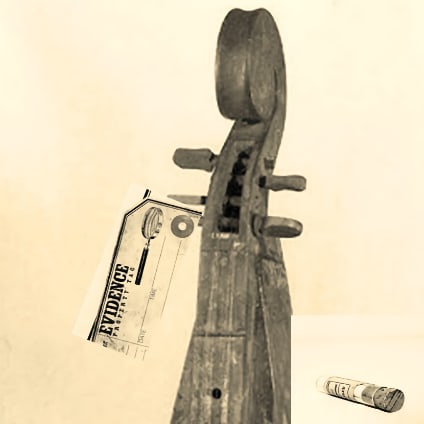
Now that 110 years have passed, I wonder what happened to that old dulcimore? Maybe it’s still in a Chicago police evidence locker.