
By David Bennett
Recently I received an unexpected gift. some of you may have read about the dulcimore belonging to Archie Lee’s grandmother either in Fall 1985 issue of Dulcimer Players News (DPN) (https://www.dpnews.com) or in Appendix E of Ralph Lee Smith’s book, THE STORY of the DULCIMER (which I’ll refer to several times below).
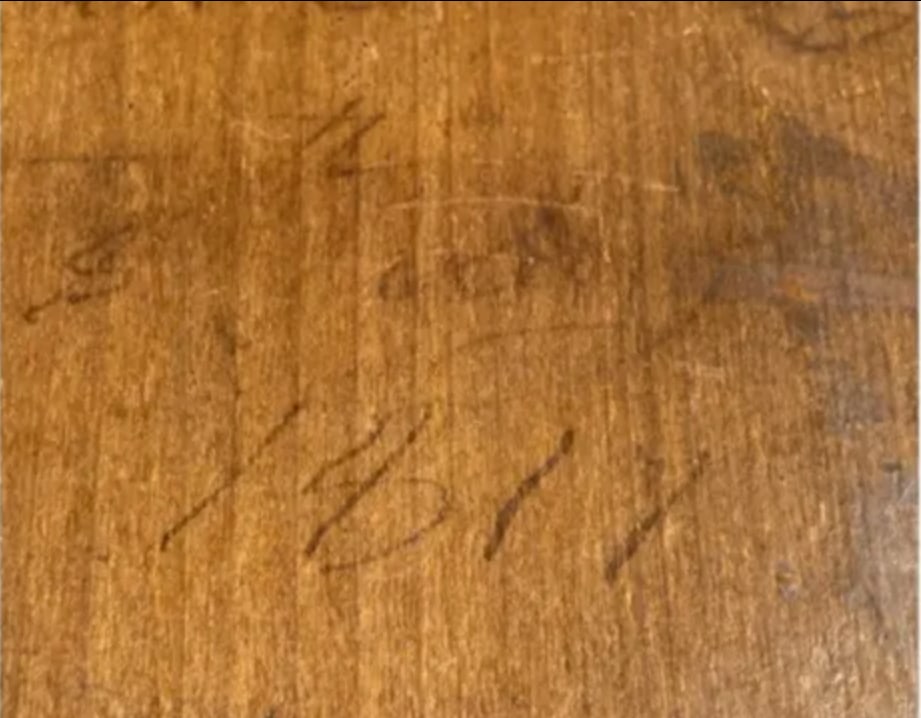
Clearly, this is a rather famous dulcimore in part for what has been written on the back, among other things a date “1817.” Before I begin, let me just say I have no new theories, or nothing to add about the date “1817” other than what Archie Laine Lee and Ralph Lee Smith have already said and written previously. Archie beieved that was the date of the instrument. Ralph Lee Smith at least entertained the idea. But that is not the point of this post. There is no doubt this is an old dulcimore.
Others may disagree but for me this instrument ranks up there with the John Scales 1832 dulcimore and the dulcimore made about 1838 by Ely Boggs (1781-1869) for Elizabeth Maggard (1823-1887). By the way, Boggs was the great-great-great-great grandfather of Mike Slone.
That being said I will tell you about my observations of the gift I was given and go over the history of this instrument some more below.
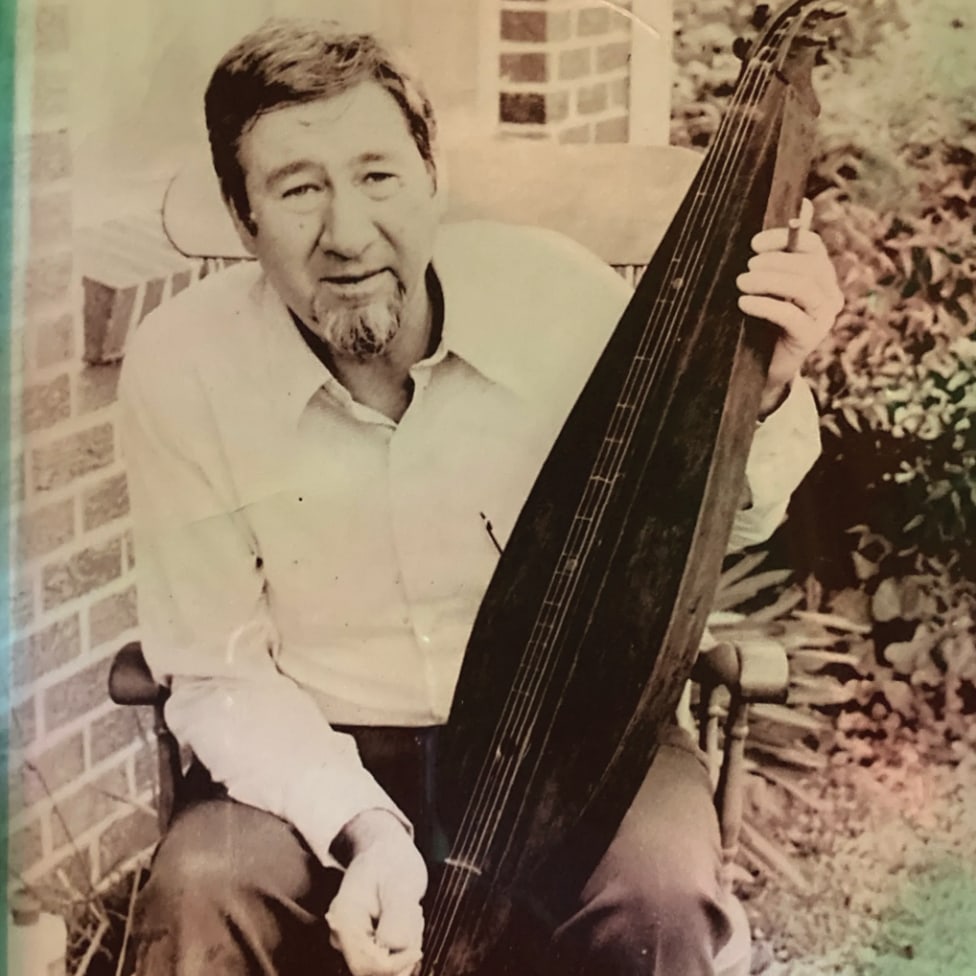
What got me started on all this is about 11 years ago I was working on a dulcimentary (the term I use for my online “articles”) about Archie Lee who had lived for a time in Alabama. There is an annual dulcimer festival named in his honor, but no one I asked back then could tell me much about Archie. So, I tracked down Archie’s son now living in Texas, Laine Lee, to ask him about his father’s background and about the old dulcimore his father had received from his (Archie’s) grand-mother. Archie had an eclectic life, having played a recurring comedic character on a radio show in 1940, was wounded in WWII, was a newspaper editor, and performed with his dulcimore at folk festivals in the 1950s. Laine was very helpful and in addition to answering my questions he sent me some updated photos that he took of the dulcimore. Keep in mind that at no time did I express a desire to obtain this dulcimore. Time marched on…
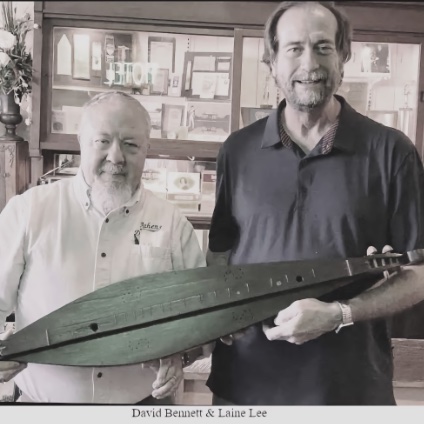
So 11 years later, September 2025, out of the clear blue Laine Lee contacted me saying he was going to be in the area (Red Bay, Alabama) and knowing of my interest in the history of dulcimores offered to make me a gift of his father’s dulcimore. Needless to say this was quite unexpected. Karen and I met Laine and his wife a few weeks later at the Red Bay Museum https://www.redbaymuseum.com/ (run by his childhood friend and fellow classmate, Scott Kennedy). Thanks again Laine!!! BTW the Red Bay Museum is worth the trip if you ever get to N.W. Alabama along the Mississippi state line.
MY INITIAL OBSERVATIONS OF THE INSTRUMENT ONCE I FIRST GOT IT HOME:
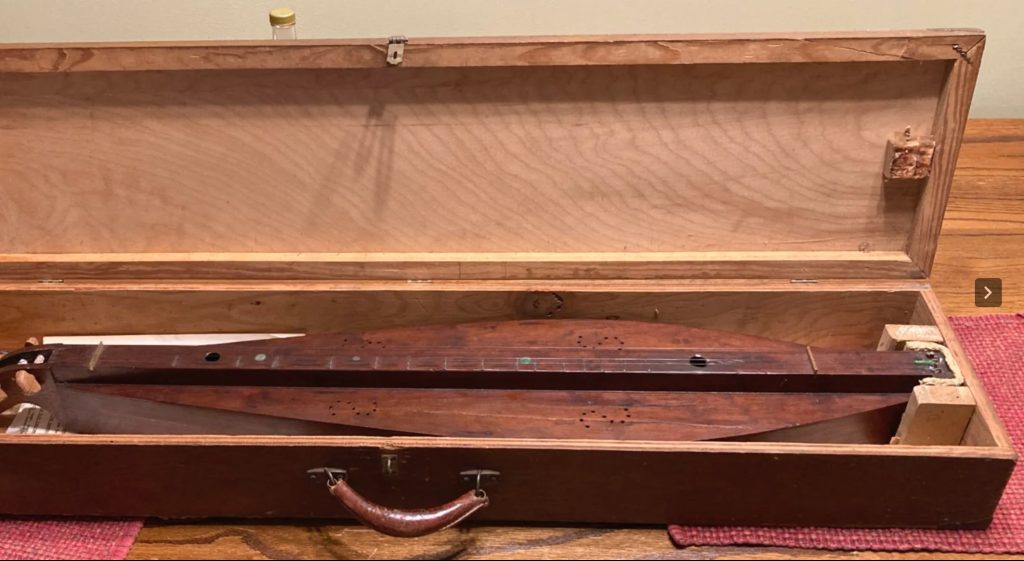
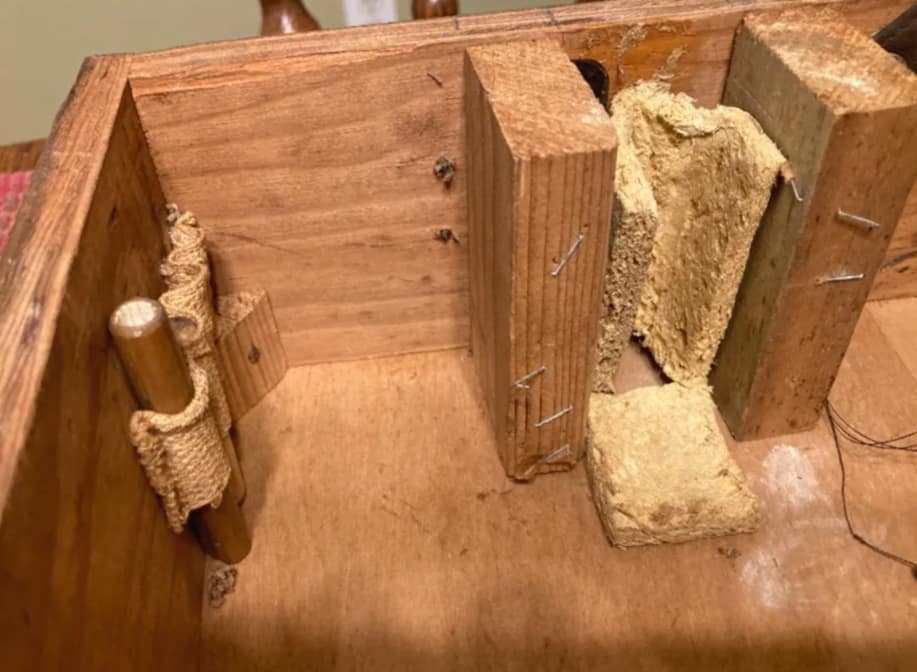
- The dulcimore is housed in a wooden carrying case made by Archie that protects it well.
- In the case was a letter written in 1991 to Paul Andry of Mandeville, Louisiana, “I’m sorry to say that my knowledge of the history of my antique dulcimer is very limited. I could kick myself for not having asked my grandmother, Mrs. Alice (Mac) Guffey Lee Thrasher, lots of questions about it, although I don’t know just how much SHE knew about it. It was hers as far back as I knew her, of course, and as far as my father knew, too… She had passed on before I ever attempted to play it, [? in ?] 1951.” His grandmother died in 1950.
- This dulcimore definitely shows a lot of wear and tear, not surprising considering the age of the instrument.
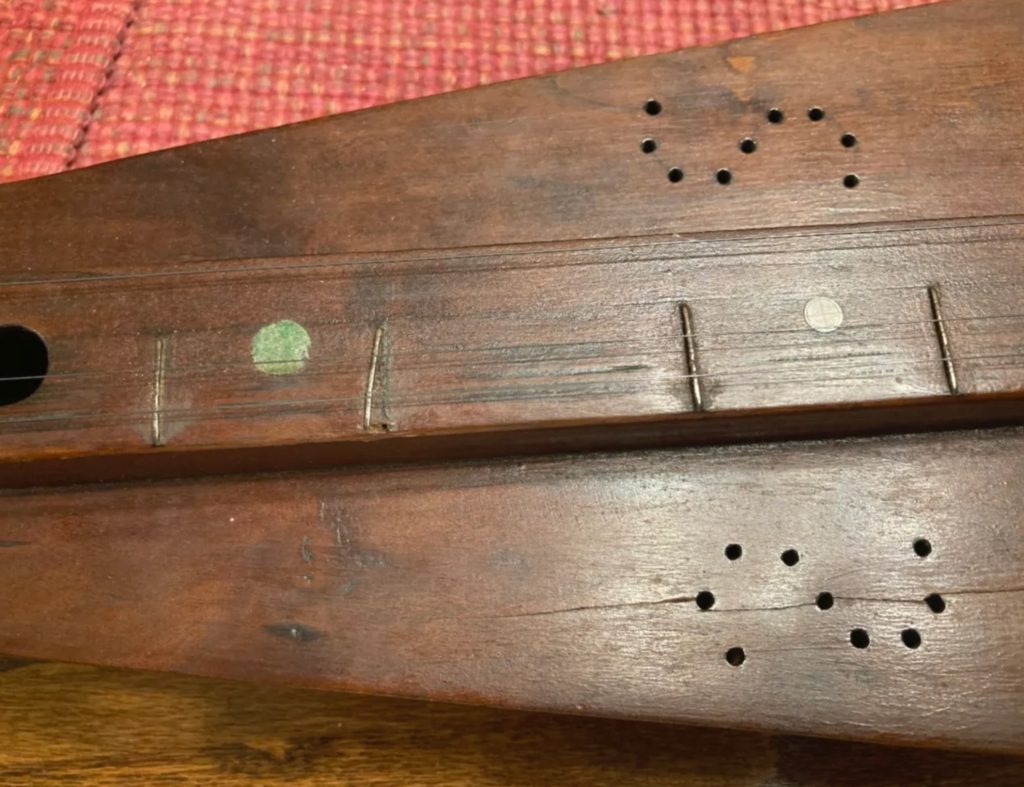
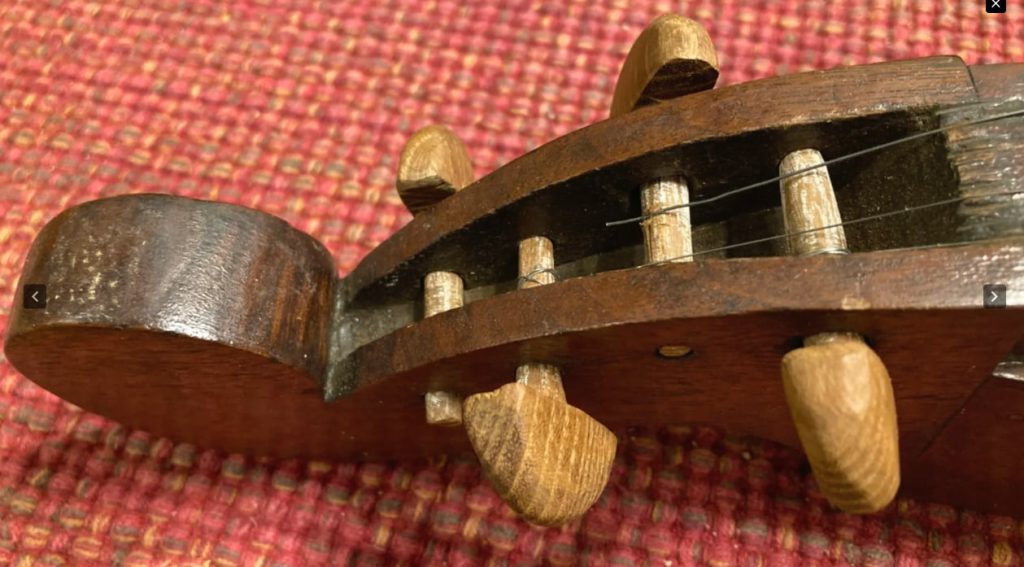
- When the instrument was made it had iron tuning pins and in the case when I got it were two of the pins. Archie wrote in the 1991 letter mentioned above that when he got the instrument, “Only two of the original wrought iron tuning pegs were left, and I made four wooded ones. There were already four holes for them.” Surprisingly to me, I’ve been told that hand made metal tuners didn’t last very long and were often replaced with wooden tuners. Bobby Ratliff told me, “the current tuning pegs appear to be Osage”.
- Also in the case were feathers that were falling apart and a couple of noters. There was also a sheet of some sort of stiff material that looked like plectrums had probably been cut out of it.
- Inside the dulcimore is a rattlesnake rattle that Laine said his father put in to keep bugs out
DAMAGE AND REPAIR:
- In the 1991 letter that I referenced above Archie said that when he took ownership of the dulcimer than in addition to him replacing the metal tuning pegs with wooden ones that he made, “It had to have new bridges, etc. then, which I made myself”
- As you look at the dulcimore there is a long crack on the left side of the top of the dulcimore, and there is a long crack on the left side (the part between the top and bottom of the instrument).
- On the bottom there is at least one spot where it is a bit loose where the bottom joins the side.
- From Ralph Lee Smith’s book, THE STORY of the DULCIMER, 2nd edition, in Appen E he says regarding the instrument’s “Virginia Tradition” it has, “A slight trace of a broken-off tailpiece that projected from the top of the block, is visible. Nearly invisible in this photo is a second rough place near the bottom of the block, of the same width as the top. A decorative tailpiece apparently joined the block at these points, and it seems reasonable to believe that it was of the “open-D” style. The missing tailpiece was apparently a good deal narrower than the foot itself.”
BACKGROUND INFORMATION ABOUT ARCHIE LAINE LEE:
- Archie Laine Lee July 26, 1920 – September 4, 2001
- Archie Lee was born in Clinton, Kentucky and lived for a time in Albany, Kentucky, near the Kentucky-Tennessee state line.
- Over the years Archie also lived in Ocala, Florida; Memphis, Tennessee; Red Bay & Russellville, Alabama; and San Antonio, Texas.
- In the early 1940s, prior to going into the Army, Archie played a comedic character named “Little Clifford” on a popular radio program, The Renfro Valley Barn Dance. By this time the radio show had moved from Cincinnati, Ohio to Mt. Vernon, Kentucky.
- During World War II, he served in the Army as a corporal and he was awarded a Purple Heart.
- From at least 1955 through 1958, Archie performed playing his grandmother’s dulcimore at the Florida Folk Festival held at the Stephen Foster Memorial in White Springs, Florida, not far from the Georgia state line. See video links below.
- Archie was the editor of the Red Bay News in the 70s and 80s. He wrote a column called “Archways,” sharing his homespun philosophies.
- For a time Archie was president of the Ala-Sippi Dulcimer Association. He was also active in the Southern Appalachian Dulcimer (SADA) club in the Birmingham, Alabama area, as well as being involved with clubs in the Huntsville, Alabama area.
- In 2001 Archie and Annie moved to San Antonio, Texas, to be near their son. They are both buried in the Fort Sam Houston National Cemetery in San Antonio, Texas.
- The Archie Lee Memorial Dulcimer Festival was an annual event sponsored by the Ala-sippi Dulcimer Association each October. It used to be held at the Tishomingo State Park in Mississippi, on the Natchez Parkway, but has moved to Fulton, Mississippi.
ARCHIE HAS SPOKEN AND WRITTEN THE FOLLOWING ABOUT HIS GRANDMOTHER’S DULCIMORE:
- In 1955 Archie said the dulcimore had been in the family at least 138 years which puts it at 1817 (1817 is written on the back of the dulcimore).
- The instrument is attributed to maker Soll Guffey from Rowena, Kentucky.
- Archie called it a “dulcimore” and said that’s what people in his part of Kentucky called dulcimers
- “It wasn’t easy getting Grandma to play the old family heirloom mountain dulcimer. All the days of my childhood in south-central Kentucky I can remember its being taken down from the top of the tall cherry secretary only on three or four occasions.”
- “It was a great treat for all of us when Grandma took the instrument down and played one or two old fiddle tunes. Grandma didn’t know any tunes except dance tunes.”
- “I do remember two tunes that were played almost every time – Bonaparte’s Retreat and Sweet Sixteen. Sweet Sixteen is more commonly known as Soldier’s Joy today.”
- “It is made of cherry.”
- “The top is made from one piece of wood.”
- “It has no bracing whatever inside.”
- The fingerboard is hollow with two small sound holes between frets. As stated above Archie replaced the bridges and added the four wooden tuning pegs.
- “The instrument itself has changed color considerably. The top and sides are as dark as most walnut, but the back was not varnished. After giving it a lot of thought and consulting a few people I trusted, I finally decided to remove the several layers of crackled varnish, which improved the tone as my consultants had suggested it would. That tone, incidentally, is not bad at all, but a couple of the staple-type frets under the melody string do need repositioning.”
- In 1985 Archie told Ralph Lee Smith, “My grandmother, Alice, probably got it from her father… It’s quite possible my great-great-grandfather could have made it in his later years.”
- “Most of this information comes from a faded inscription on the back of the instrument. Since it was written in artistic, but hard-to-read Spencerian * penmanship, I can’t be too certain about some of the things written in small print.”
- Nina Keenam, Andalusia Star News 9/7/2013 wrote that Archie’s grandmother left him the dulcimore because he was the only grandchild that was musically inclined, “but at the time, it meant nothing to him.”
o When he heard a dulcimer recital at the University of Kentucky by Dr. Grimes of Nashville, it piqued his interest in the instrument and he retrieved his grandmother’s dulcimer out of the attic.- * Spencerian penmanship is an elegant style of cursive handwriting developed in the 19th century by Platt Rogers Spencer, known for its graceful curves and flowing strokes. It was widely used from approximately 1850 to 1925 in the United States for business correspondence and education until the rise of simpler handwriting methods in the 1920s.
THINGS THAT MAKE YOU GO “HMMMM…”
Just so you know I am a musical Luddite, so I am unable to comment on this other than to report what I’ve been told. Perhaps some of you know how this works.
- On May 3, 1955 at the Tuesday evening performances at the Florida Folk Festival while describing the history of the dulcimore and in particular his grandmother’s dulcimore, “…I turned it backwards, I’m sorry… I didn’t explain last night if some of you were here, I said I would explain later why I was switching ends with the instrument, so I better explain that right now so we don’t forget. Turned this way you play it in the minor key, you turn it the other way you play it in major key. It’s that simple… There’s only two keys you can play it.”
- Sunday performances at the 1956 Florida Folk Festival Archie repeats this, “This is the perfect lazy man’s instrument because you almost have to be to be sitting down to play it and if you want to keep it handy you can always just reach up and grab it because it doesn’t matter which end you turn it if you’re not especially particular whether you’re playing in a minor or major key. Turned this way we are in a minor key… turn it this way you’re in a major key.“
Source: starting at about the 3:55 mark https://www.floridamemory.com/items/show/239524 - Archie’s son, Laine Lee, told me, “I often heard him explain that he had never encountered another mountain dulcimer besides his own that could be rotated 180 degrees to generate a tonic minor triad. He mentions that property in the Wayfaring Stranger segment you linked, but I can’t tell you whether there were any other changes in technique that were required to play those minor key songs. That’s one thing I wish I had talked to him about in more detail.”
- The instrument has a couple little temporary paper position dots on the fret board and at this time the only reason I have not removed them is because “maybe” they have something to do with 180 degree minor/major discussion.
- If anyone has any thoughts on this or can explain it I’d love to hear from you.
SO HOW OLD IS IT?
From everything I read Archie wrote or say Archie believed the instrument had been in his family since 1817. I’m not saying it wasn’t because obviously I don’t know. I do believe that it is very old and that it was in his family a very long time. Regarding the possible age of this dulcimore Ralph Lee Smith corresponded with Archie Lee, and in 1986 wrote in his book THE STORY of the DULCIMER in Appendix E, “Although the instrument was apparently made in Kentucky, it belongs to the Virginia style and tradition… If Archie’s dulcimer was made in 1817, it pushes the Virginia tradition back some fifteen years from the instrument made by John Scales. One should presumably allow an additional period of time for the Virginia tradition to migrate to Kentucky by way of an early settler. We thus find ourselves approaching the turn of the century in our backward quest. Our inquiry seems to end where it began — in the mists of the 18th Century Appalachian frontier.”
To view the original article, more photos and see the genealogy, visit heritagedulcimers
