
by Ryan Dooley for the Tennessee State Museum”
Though it goes by many names, the Appalachian, mountain, lap, plucked, fretted dulcimer does not get the recognition it deserves. Its unique history and connections to Tennessee have often been relegated to folk music revivals from almost a century ago. It is difficult to champion such a humble and unassuming force of roots music. The dulcimer is quieter than other folk instruments and often lost in the mix of ensemble playing. It is typically used to accompany ballads or single vocalists and is normally played sitting down. It is not exactly an electric guitar. However, after a quick study of the instrument and its practitioners, it is undeniable that this specialized instrument is an integral part of both American musical heritage and regional Tennessee music.
Origins of the Instrument
Most contemporary scholars agree that its physical form evolved from the scheitholt, a European instrument. “Scheitholt” is a German word that refers to the instrument’s shape, which resembles firewood cut into logs. In 17th and 18th century Germany and Scandinavia, this folk instrument was often ignored by elites who deemed it an antiquated relic of the peasantry. But as working-class immigrants settled in Pennsylvania, they became the musical “tastemakers” of the region, and scheitholts became mainstays of early American musical culture. By the late 18th century, these settlers traveled southward on the Great Wagon Road in search of available land on the western frontier. Cultural homogeneity began to break down as Dutch and German religious and ethnic communities interacted with English, Scottish, Irish, Scots-Irish, Native American, and enslaved individuals from West Africa and the Caribbean. The sojourners brought their scheitholts with them as they settled in places like Virginia, Kentucky, Ohio, and Tennessee.
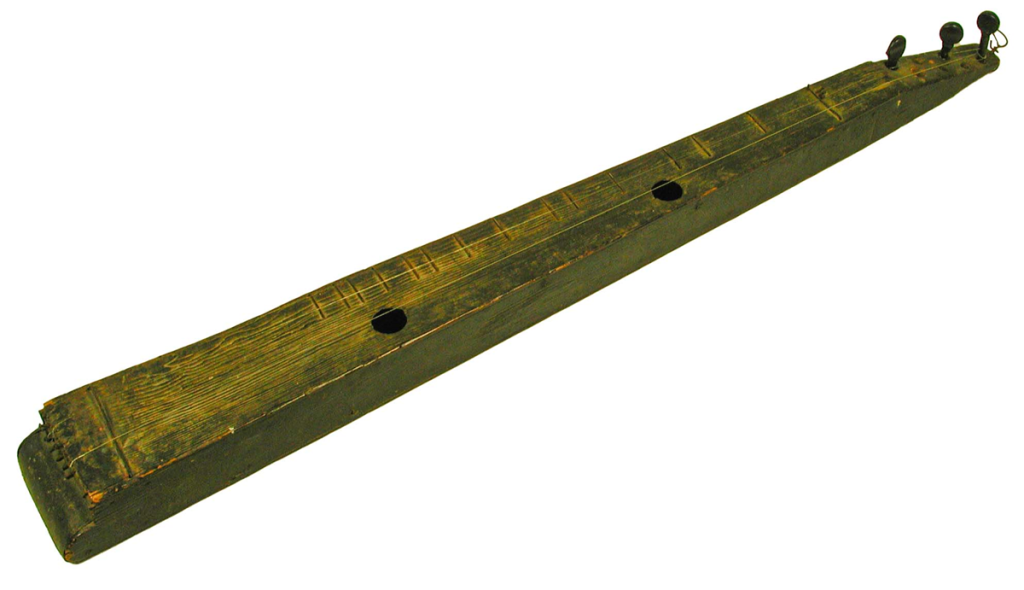
The scheitholt was a traditional German stringed instrument innovative in its simplicity. These instruments consist of a rectangular wooden soundbox with strings threaded through tuning heads and stretched over a nut and bridge, terminating into a tailpiece that was all part of the same piece of wood. The playing surface included frets for noting melodies and unfretted drone strings to accompany the fretted notes. 2006.143.4
Evolution of the Instrument
Estate records and other sources show that the word “dulcimer” was introduced by the late 18th century to describe the German scheitholt and similar zithers. The scheitholt’s name change marks the beginning of the European instrument’s metamorphosis and assimilation into a new, American musical culture. The new name can be attributed to exposure to the English-speaking majority on the Great Wagon Road and settlements in the Shenandoah Valley.[1] As German settlers integrated with other nationalities and cultures, their ties to their native countries lessened, and they began to adopt linguistic and cultural changes into their rapidly evolving daily practices.
Americans called their instrument the dulcimer, an English word historically used to describe a broad range of zithers from around the world but in this new 19th century context, it specified this particular instrument. Another change affected the instrument. It began to evolve in physical appearance and sound. While it is impossible to say when or where these alterations began, it is apparent through early sources like probates and inventories that the “dulcimer” morphed into something markedly American by 1832.
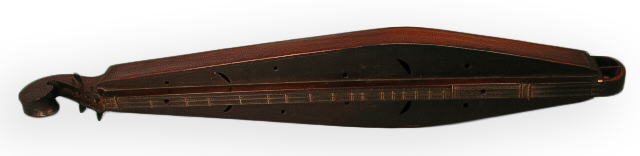
This early dulcimer was made in Sneedville, Tennessee, in 1832 by Dr. Neal McNeil. This example of an early dulcimer shows how the instrument evolved from the scheitholt (pictured above 2006.143.4). It features extended sides or “boughs,” an elevated fingerboard, fiddle-like tuning pegs, a strum hollow, or depression in the fingerboard to provide ease in strumming, and a D-shaped tailpiece. This dulcimer features three strings: A lead string to play the melody and two drone strings to accompany the melody. These alterations made the dulcimer easier to play in ensembles and increased the instrument’s sustainability and volume. 84.32
It is not known why these newly American musicians and artisans chose to transform the scheitholt into the dulcimer, but there are theories. The timber from their new settlements could have provided better opportunities for sonic quality and structural changes. The instrument possibly required alterations so it could be played at different speeds and keys that were more conducive with new instrument ensembles and music types. The scheitholt also potentially needed to be physically and figuratively transformed so a new instrument representative of this new collective culture could emerge. After adopting a new name and changing physical form, altering its sound, the dulcimer was incorporated into different types of music. Soon, British, Irish, Scottish, and Scots-Irish songs like airs, ballads, hornpipes, and reels were being played on the dulcimer. Enslaved musicians likely introduced certain syncopations and flattened and sharpened notes, altering traditional western folk and religious music. Additionally, some dulcimers show evidence of being played with metal slides, a non-European technique likely introduced by enslaved individuals and honed by generations of African American musicians. New religious movements in the United States introduced unique non-secular music which often included instrumental accompaniment from the docile dulcimer, an instrument considered more pious and subtle than fiddles or banjos—instruments associated with merriment and dancing.
As settlers migrated further west, the American dulcimer was transported along routes like the Wilderness Road and down various waterways, expanding its footprint. While European-born instruments like the fiddle and piano remained essentially unchanged in form and playing styles, other American-born instruments like the banjo and dulcimer, and musical traditions like Shape Note Singing were frequently evolving to meet the musical and cultural needs specific to a location.
While routes were culturally diverse, many of the resulting settlements in southwest Virginia, Kentucky, Tennessee and western North Carolina were increasingly isolated until the late 19th century. Dulcimer historian Ralph Lee Smith suggested that it was this isolation that led to the variance in physical structure, but it also undoubtedly led to disparities in playing style.[2] Additionally, access to mass-produced goods like metal strings, modern tuning machines, glues, and other materials would have dictated how the instruments could have been constructed, tuned, and subsequently played.
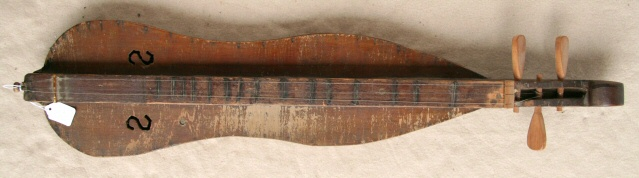
This dulcimer was reportedly made around 1900. Note that the frets on this instrument cross the entire fingerboard, allowing for additional noting on the melody and drone strings. Pennsylvania Dutch “hearts,” S-shape carvings, crescent moons, stars, and traditional violin f-holes are all common motifs in dulcimers, though some related to a specific time period or location. 2006.143.13
While the changes that led to the American dulcimer may seem arbitrary, they are important evolutionary markers that represent both technological and cultural shifts. Ralph Lee Smith explained the morphology from simply scheitholt to the more complex dulcimer, noting, “This new instrument solves three problems associated with the scheitholt. It is louder, more stable, and adaptable to playing lively music by strumming without damaging the body.”[3] With a basic form established, the American dulcimer began to evolve to regional preferences. In areas where ensemble playing was common, dulcimers featured larger, sturdier bases and sometimes included strumming “scoops” or concave recessions in the fretboard to allow back-and-forth strumming. In situations where musicians played by themselves, innovations in enhancing tone and speed were not pursued as much, and stylistic innovations such as alternate tunings, using a bow, slide, or fretting rod, helped players differentiate themselves from their musical peers.
Eventually these traditions solidified, and these styles began to be associated with geography instead of performance style and repertoire. Virginia-style dulcimers “have bodies that expand out from the top to a single wide point or bout. [They] have hollowed out fretboards into which sound holes have been drilled…they feature F-holes and S-holes, they do not have strum hollows and usually have decorative tailpieces of semi-circular design.”[4] In the more-established eastern part of Tennessee, the instrument features “light, delicate, and graceful hourglass teardrop curves made from thin hardwoods such as walnut or cherry.”[5] East Tennessee dulcimers often feature ornate carvings and sound holes, intricately carved tuning pegs, and elaborate scrolls on the headstocks and tailpieces of the instrument. There are playing styles and dulcimer shapes specific to eastern Kentucky and western North Carolina, as well.
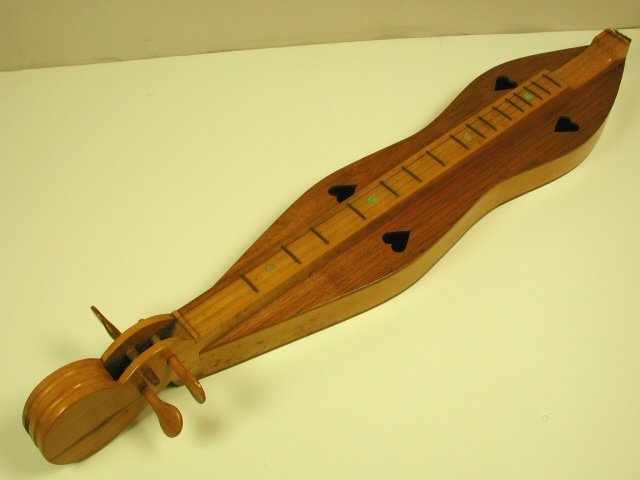
David Scnaufer collected this hourglass dulcimer which features heart-shaped sound holes. This style of dulcimer is called the “Huntington Pattern” and was popular in Kentucky. This style was preferred by dulcimer advocate and eastern Kentucky-native Jean Ritchie and her father, Balis. 2006.143.16.1
The Tennessee Music Box
Another type of dulcimer appeared in southern Middle Tennessee around the mid-19th century. Called Tennessee Music Boxes, these instruments lack the intricate craftsmanship of their eastern counterparts but are tuned, played, and incorporated into culture similarly. Researchers of the Tennessee Music Box describe its simpler design noting, “The farming communities of southern Middle Tennessee produced an instrument that found its grace in the sound it made rather than its outward appearance. …they are made from the materials at hand.”[6] It is a mystery why the dulcimer evolved so quickly, incorporating intricate carvings and machinery while the Tennessee Music Box remained more minimalist. It is possible that it was just a matter of time. Dulcimers existed in the southern Appalachian regions for almost a century prior to the creation and proliferation of the Tennessee Music Boxes of southern Middle Tennessee. However different in appearance, the proliferation of both types of instruments, throughout East and Middle Tennessee attest to the importance of music to daily life and culture.
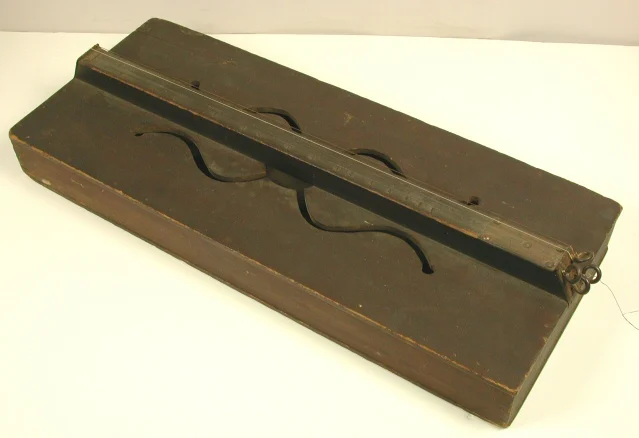
This Tennessee Music Box was made around 1900, likely near Pulaski, Tennessee. The box features a simple square design, elevated fingerboard, and lyre-shaped sound holes. It is strung with piano wire and tuned with austere eye hooks instead of decorative tuners. 2006.143.18
Advocacy and Education in the 21st Century
Almost a century after its creation and integration into American culture and folk music, fretted dulcimer popularity waned considerably. By the mid-20th and especially by the 21st century, the average American would not have recognized the instrument and playing traditions that were largely confined to bluegrass and old-time festivals and the occasional coffee shop performance. If the quiet, unassuming instrument was to survive the next century, it needed worthy advocates.
David Schnaufer was born in Texas in 1952. He was engrossed with the fretted dulcimer in his youth and developed an innovative melodic style that expanded the traditional boundaries of the instrument. Under Schnaufer’s direction, well-worn playing styles were given new life and his invigorated playing style was in high demand from musicians of new genres, including rock artists like Mark Knopfler, Linda Ronstadt, Emmylou Harris, Chet Atkins, and others. In the early 1980s, Schnaufer moved to Nashville and as part of the inaugural faculty of Vanderbilt University’s Blair School of Music Folk Department, he brought the centuries old sounds of the lap dulcimer back to Music City. At his new post, Schnaufer collaborated with expert musicians of multiple genres and taught both his own innovative playing style and traditional methodologies to a litany of eager students. One such student was pop musician Cindi Lauper. With the help of fellow dulcimer enthusiasts like Sandy Conatser, Schnaufer collected various dulcimer specimens from all over the United States and co-published invaluable articles and photographs interpreting the materials, shapes, and sonic properties of the instruments. Schnaufer passed away in 2006 after a battle with cancer. His instruments are at the heart of the Museum’s dulcimer collection, and his research findings are foundational in the field today.
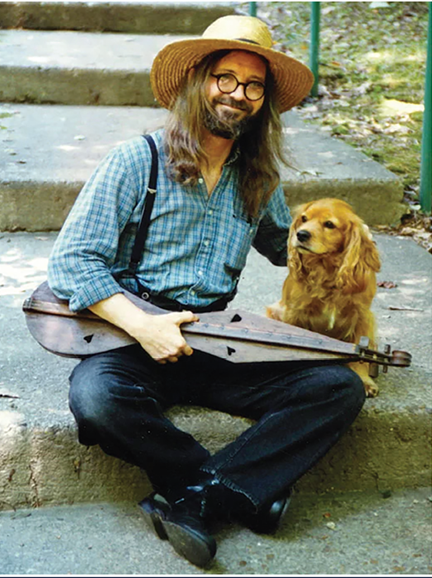
David Schnaufer, 1990s courtesy of Sandy Conatser
The instruments, their innovators, and their players set the underpinnings of a folk tradition that would come to shape not only Tennessee’s musical traditions but the entire musical culture of America. Thanks to the hard work of folk music and dulcimer advocates of the 20th and 21st centuries, scholars and music fans alike better understand the history of the fretted dulcimer and how it continues to shape music played at home, on records, and live at some of the most renowned venues in the world.
- This article was originally published on the Tennessee State Museum’s Thousands of Stories blog at TNMuseum.org. © 2026 Tennessee State Museum. Reprinted with permission.

Ryan Dooley is the Tennessee State Museum Senior Curator of Music
- This article was originally published on the Tennessee State Museum’s Thousands of Stories blog at TNMuseum.org. © 2026 Tennessee State Museum. Reprinted with permission.