
An interview with John McCutcheon by Mark Dettmer
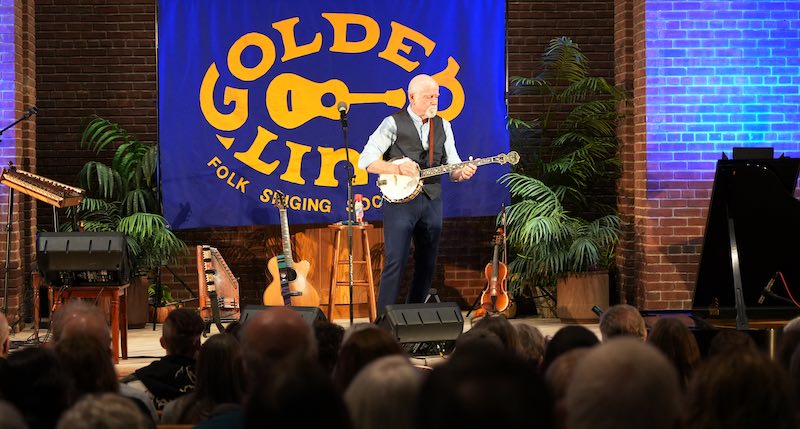 It might have been on my bucket list to shake hands with someone who truly knew I.D. Stamper. So when I heard that John McCutcheon was doing a concert two hours east of home, the decision was made for me. When I mentioned the big anniversary to DPN, it was strongly suggested I try to see if John had time to sit down for an in-depth article, as this quarter’s issue was tag-lined, “Traditions.” One could hardly think the word Tradition without recognizing John for his Appalachian music research, and for passing on his work to the next generation. Tommy Slothower, McCutcheon’s road manager of thirty five years, gave me the news that an interview was approved. It became apparent that both John and I felt strongly about I.D. Stamper’s legacy – ironically something I would not have known about had John McCutcheon himself not made his way to Letcher County, Kentucky a half century earlier.
MD - It’s been fifty years since the film, Sourwood Mountain Dulcimers, featuring I.D. Stamper and yourself came out. Has it surprised you that the interest in this work has never ceased?
JM - No, I didn’t realize that the interest in the film had never ceased. I met I.D. Stamper at a festival in Wise, Virginia with Dock Boggs – who’s a famous banjo player who lived in that area. And I was doing a little set, and I was playing a little homemade fretless banjo that I’d made, first banjo I ever owned, and then, after me came I.D.
And he, as my friend George Reynolds, from southwest Virginia used to say, He knocked my hat in the creek. He was just so completely different from any dulcimer player I’d ever heard. And I said, I really need to meet this guy.
He was fascinated by the fact that I was playing a home-made banjo, and his dulcimers he made himself. They’re about this big and this wide [long compared to most], and they’re tuned very low. He made other dulcimers and I have, I think, three of his instruments.
And he just played with a kind of drive, and so many white musicians in eastern Kentucky were really influenced by black musicians, and it was absolutely apparent from his playing.
So we made a date for me to go and visit him, and… I was doing a lot of recording of rural musicians around the Appalachian south. And so I thought, oh, well, this guy is the crème de la crème. He was playing an instrument that I hadn’t seen very many people play, because the mountain dulcimer is not that prevalent in Appalachia – not like the banjo or the fiddle or the guitar, of course. And he plays in a way I’d never heard it ever played before.
So I went to his house, he lived in a little mobile home in this place called Thornton, Kentucky which is in Leicester County, not far from Whitesburg, where Appalshop is. And my M.O. when I was going to hopefully record someone is, I wouldn’t bring anything in. I would just sit and visit with them, and make them feel comfortable, and play a little music. And I finally said, Mr. Stamper (at that point I was still calling him Mr. Stamper), my memory is not as good as it ought to be, and I would really like to have some of your music to listen to. Would you mind if I brought in a tape recorder? And he said, I’m so glad you asked, because I wanted to tape you!
Everything about our relationship was like that. He viewed me as a partner, as a peer, from the very beginning. He was a really good harmonica player, and a pretty nice banjo player. He’s a good singer. And we’d do shows together. And he, at one point said to me, “You know, if you’re a good mule driver, you have a young mule, and an old mule, because the old mule knows how to do it, and the young mule has all the energy and all the strength, and together they’re a great team.” And then he leaned in and said, “You understand what I’m talking about?”
And he was proposing that we make music together. And both of us had just made music on our own.
Yeah, he was a remarkable guy, and a fantastic musician. And he’s the only musician that I ever studied with that I wanted to play exactly like him.
With everybody else, it was like, I’m going to put this is the pot, and it’s going to be, on the banjo it’s gonna be Roscoe Holcomb and Obray Ramsay, and you know, Wade Ward, and all these different people, and what’s going to come out is going to be a conglomerate of all that.
With I.D., I wanted to play exactly like him. He’s the only musician that I ever spent any time with that that was the case.
MD - It’s interesting that you say that – I don’t think you are alone in that mindset either. The Appalachian dulcimer seems to be making a somewhat surprising comeback with Gen Z and younger players and they are actually looking for the traditional ways. Many say the honesty of the instrument and one’s ability to quickly learn to play the basics is part of the story. But how easy is it to learn to play the way I.D. Stamper did, or the way you play it now?
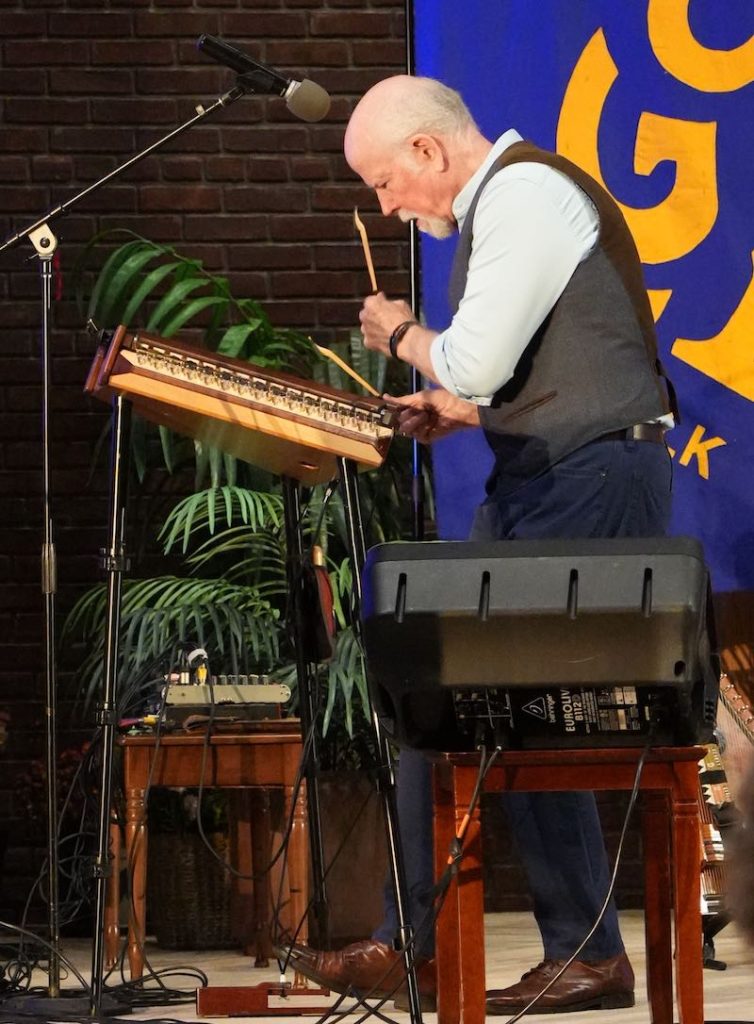 JM - Well, with I.D., he used a noter, which a lot of younger players do not use. Jean Ritchie, for instance, rarely used a noter. There was a period of time, because I was taking I.D. around to a lot of these dulcimer festivals, and I let him play the dulcimer, because why would you want to hear me imitating the master? I just focused on hammer dulcimer then, because there weren’t a lot of people playing hammer dulcimer at that time. I think that the difference between me then, and Gen Z now, is, that my intention was to get thoroughly down and dirty with the tradition itself.
I wanted to know what and how, that’s why I came south. I was raised in Wisconsin, I was in college in Minnesota, learning to play the banjo, and I convinced my advisor to let me take a three month independent study traveling around the Appalachians and meeting banjo players.
And the thing is, in college everything is so compartmentalized. You know, you go into a room to learn English literature of the nineteenth century, and a professional instructor teaches you that, to the exclusion of everything else in the world. There’s no science, there’s no theology, there’s no music, nothing. You are right there in that world.
When I came down here [Appalachia], I was dealing with people who weren’t teachers, who just played. And I had to learn how to listen, which is a lost art (even fifty years ago). And I had to learn to remember, I had to learn to identify what stuff I didn’t understand. And I had to learn that this was going to be in the mix of a bunch of sounds. It’s not just going to be a banjo player, because if somebody heard there was a musician over at Roscoe’s house, well, here comes a mandolin player, and here comes a fiddle player, here comes a standup bass player - it was a party!
It was not long before I was trying to learn how to play the fiddle, and I was revisiting the guitar, and I learned to play the auto harp, and that’s how I learned to play the fiddle and the hammer dulcimer and all these things. And mountain dulcimer. I think I started to learn to play the mountain dulcimer because I admired Jean Ritchie so much. She was my first song writing hero, because she wrote songs that sounded like old songs. She’s such a good song writer, a lot of people don’t know she writes songs. Cool of the Day? I mean, come on! I defy anybody to hear that for the first time and say, She wrote that?
So I just started messing around on the dulcimer, because it was just another thing, and I was in a learning mode, and there was no, “No,” in my vocabulary. If heard about somebody who played the dulcimer, I would go, and if I hear about somebody who played the banjo, I would go. But I never went back to college. I often say it’s a three month independent study that I’m still on 53 years later, because it’s a big subject. I mean, you meet somebody like I.D. Stamper and you say, I’m going to go back and sit in a classroom now? No, this is the big classroom and it’s kept me curious and energized for all these years.
So as far as your actual question, I think whereas I was going to the wellspring... So, I was starting with a bit of a handicap because I didn’t want to stray too far from the tradition. I eventually did, and learned how to do that. Because Roscoe Holcomb didn’t want to listen to a little musical parrot. He wanted to play music with somebody, he wanted to hear what my music was like. Which is why ID said, I want to tape you, too. And we rarely played the same instruments at the same time.
Young people are unburdened by the tradition. I remember, I was hired to do a hammer dulcimer recording session with Paul Simon and he just heard the hammer dulcimer, and said, I like that sound. He didn’t attach it to any tradition. He said, I have a place in my music for that sound. And I think that’s pretty common now, which makes it really exciting. Some people are, you know, stay in the lane. And with me, it’s like, if I’ve learned anything from people like I.D., and all the many teachers who were patient enough to put up with me, it’s that this is a living and evolving thing. These aren’t museum pieces, this is art. However rough and rowdy it might be, this is people getting what’s inside outside, which is my basic definition of art. So I’m happy to hear young people doing crazy s**t! I think it’s great!”
MD - Many people give you well deserved credit for searching out and preserving for history’s sake the old time musicians and folk songs. But do people really know where to look for this treasure? What resources do you recommend people consider using to get the best information and motivation from your efforts? And I’ll throw in a side here: Some say there are too many different ways to approach the mountain dulcimer and young people are trying to start with the noter, trying to go back to tradition.
JM - Cool!
MD - ...and when we tell them about some of these historical gems like your film and other learning essential assets that are out there, they claim they can’t easily find them, and these are pretty smart folk. What do you feel are some of the best resources?
JM - One of the things I discovered early on was the Library of Congress Archive of American Folk Songs. I mean, it’s where the teenage Pete Seeger went, and it’s a repository. All the field recordings I’ve done are there. And you can go in there, and it’s not an archive in the sense of the word - like the Woody Guthrie archive, you go in there with white gloves, and they’re not handing you the original lyrics, they have made photocopies. If for some reason you need or want to see it for a scholarly purpose, they’ll show it to you. So the Archive of American Folk Songs lives and breathes to get this out there. It’s a vibrant young staff. That’s one place.
 Smithsonian Folkways recordings – it started off as Folkways Records, and that’s the first place Pete was on there, Ledbelly, Jean Ritchie, Woody Guthrie. Moe Ash, is a guy from New York, who started it, he’s long gone now. The Smithsonian has taken that catalog, and I think the entire catalog is still there, and you can hear stuff as widely… as Stanley Hicks playing the mountain dulcimer, and John Jacob Niles playing something like a mountain dulcimer and singing in his very operatic falsetto. And there’s lots of stuff on Smithsonian Folkways.
You know, I’ve always thought that a place like DPN would be a great place to have a resource guide for exactly what you’re talking about. They know everybody. And if you put out the call, those of us who have survived and are still alive would probably say, oh yeah, here’s how you can find this stuff. If I was a twenty year old John McCutcheon today, I would eat that up.
MD - They’re out there.”
John smiled, happy to hear it and added, “That’s scary…”
MD - You’re considered one of the finest hammer dulcimer players... and your recent concert tours prove haven’t lost a thing since you were featured in the performance in the film with I.D. We get to sit back and listen to you make it look easy. As an amateur luthier I’ve restored a hammered dulcimer, so I know the build and complexity of the instrument. But I’ve never cornered the strategy on how to approach playing. How did you start? And any tips for those desiring to join in with that instrument?
JM - Well, the dulcimer is essentially a diatonic instrument. And, one of the things, whenever I was learning to play an instrument, and I’m still learning to play musical instruments, is, I try to figure out how they’re set up. You look at a piano keyboard, and there are twelve notes in a musical scale, with all the sharps and flats, and all of a sudden you see, it’s repeated, over and over, you know, ABCDE, CDEFGABC. There’s the C scale right there. But that top C is the bottom C of the next octave. I looked at a piano after taking lessons for a couple years, and went, OH! Why didn’t she tell me this from the beginning?!
Same thing with the hammer dulcimer. This is impossible to describe and have it make sense. The treble bridge, the middle bridge divides each string into two notes. And on the right side is the Do, and the left side is a Sol. It’s the same thing all the way up. So, you are going from the Do, you would go Do Re Mi Fa - go back down the other side of the bridge and play the same four notes, and you’ve got a major scale. And that top note, the Fa, is the Do of the next scale. It’s not repeated, but it’s like little blocks of four, stacked up on top of, underneath, and alongside of one another. Once I figured that out, I thought, ohh, this is a little bit like typing! You learn where these notes are and you can completely transpose from the key of D to the key of G, for instance, by moving up - four strings. And then from the key of G, because it goes, GABC, and that’s the beginning of the C scale. And so that’s the way the dulcimer is set up. And I don’t know if it was puzzle making, or whatever, but that’s how I look at instruments. I say, How is this set up?
So I think the (hammer) dulcimer is one of the simplest instruments to play. It’s different in that in all the other stringed instruments, your hands are doing different things.
On a mountain dulcimer, you’re using your fingers on the left hand, or using a noter, and you’re strumming. You’re doing something completely different. On the guitar, same thing - violin, mandolin, banjo. Once you get the coordination of doing this [John lifted his hand to the neck of an air guitar] something completely unrelated to this [his other hand strumming], you can play any of those instruments. Because that’s the big coordination hurdle.
With the hammer dulcimer, your hands are doing exactly the same thing. And because it’s diatonic, and we tend to think in our Western minds very clearly in diatonic strings. I’ve often said, in a dulcimer workshop, at a festival, for instance, where it’s not all dulcimer players, I can take anybody in this crowd and have them play a tune in five minutes, on your own. And you can, because it’s that simple.
What happens with almost everybody I’ve ever seen, is that they figure that out, they learn a bunch of tunes, and they learn a whole bunch of more tunes, and maybe they learn a few techniques. Those people who were closet drummers when they were kids – all of a sudden - Oh boy, I’ve got a couple of drumsticks in my hands, I can do little rolls, a stuff like that. Most people on almost every instrument hit a plateau, and ninety percent of people in the world never get past that plateau. But they’re giving themselves a lot of pleasure playing an instrument and sounding good. Even mistakes sound good on a hammer dulcimer.
MD - The music industry has changed dramatically in the last fifty years. The way that musicians make their living seems to have gone full circle from only touring, to recording, with record and CD sales as the main driver, and now it seems to be back to touring. What are your thoughts as to the future of folk music and folk musicians making a living?
JM - Well that’s two different things.
The future of folk music is completely solid. Because it doesn’t matter how many people are showing up at a concert like tonight. I’m an entertainer tonight. Some people would argue that I’m not a folk singer when I get up there. I’m a performer. I’m performing folk music.
In the folk music revival in the United States, in the 50s and 60s, you could count, really, on one hand, who were the hot instrumentalists, because that’s not what was driving it. You could count on one hand the people who were thought of as great singers. You could count on one hand the people who supplied most of the original songs for that movement. Today, there are young kids playing rings around me. And there are so many good singers. And song writers? OMG.
This a golden age and it has nothing to do with CD sales, or who fills Carnegie Hall, or whatever. It’s just that people are singing, and writing little songs with their families. I do these song writing camps in the summer. There are people who come in here and say, I’m a grandmother. When we have a family gathering I write a song about something or other with the family, and everybody looks forward to that, and they remember the songs. And that’s folk music!
Folk music is the root of all the world’s music. There was folk music everywhere before there was Beethoven, before there were cantors at the Wailing Wall in Jerusalem. There were people making music, and there always have been. So the health of folk music - I have absolutely no worries about that.
Making a living is another story, because there’s a lot more people trying to do it. As much as you hate to say it, there is competition out there, I mean they could’ve hired somebody else tonight, but they didn’t, they chose to hire me. And maybe there are five or six people out there hating me tonight, because their tour took them right through Rochester and this would’ve been perfect timing.
I think, I’ve made a living without making a killing. I’ve been lucky enough to play music that I’m proud of, and that pays my bills, I don’t live extravagantly, and allows me to do wacky things. Like I continue to make these documentary albums, because I think, I look around and nobody else is doing it. And I think, well, OK, it’s one hundred years since the 1925 Mountain City Fiddlers Convention. Let’s get a bunch of modern fiddle and banjo players and celebrate that.
2027 is the 100th anniversary of the Bristol sessions. I’m going to do an all Carter family album. Just because I love that music, I lived in the same county as the Carter family, and knew them all, and you know - who needs another John McCutcheon album?
MD – You do have quite a following.
JM - Hopefully people will take a chance. Maybe they know, “Will the Circle be Unbroken,” and that’s the extent of their knowledge of the Carter family. Me – it’s in my musical DNA.
So, I would wish that people could be as lucky as I’ve been, that they can play music that they’re proud of. And that they can introduce interesting ideas and thoughts and music to people, and they get to do things that enrich their lives and other people’s lives.
It’s a hard way to make a living. I mean, a lot of people get so far and they realize, No, I’m homesick all the time. Or, I’m sorry I missed my kid’s championship football game. I’m never gonna do that again. Or, I don’t sleep well when I’m not in my own bed. Or I seem to get sick when I’m on the road. And these are real things. Or, I only play in a band and I hate the people in my band - that’s a very real thing.
I was talking to a guy who was in Washington DC, a really good fiddle player, and a singer, and a performer, and he said, I play in schools during the day. I can play at a dance seven nights a week if I want to. And I said, so why do you want to go on the road?? There is more than one metric for doing this. You’re my hero! You can work seven nights a week? That means that you can say, No, because it’s my kid’s championship football game.
And you make a lot of sacrifices, and you’re two bad gigs away from so much self-doubt, and self-abuse, you know, Nobody came, I didn’t make any money, I have to sleep in my car, go to a hotel, or sleep on somebody’s floor, or, Nobody likes me, I didn’t sell any merch. So, this liquor bottle looks pretty good, I know I’ll feel better on the other side of that. Or, this cocaine looks pretty good, I can make myself feel good, or that woman over there would make me feel good. And none of that makes you feel good, really.
But that’s reality. So keep your head. Keep your heart. Don’t make the road entirely different. I called my kids every night at bedtime. I call my grandkids. I go the gym every day, because that’s what I do at home. I go to church on Sunday because that’s what I do at home. I try to not make this whole other life.
My father was a traveling salesman and he had a whole other life. It took him two days to get out of that on the weekend, and then it was time for him to leave.”
With that last sentence, ironically, I told John I owed it to his concert for me to end the interview. Waiting down the hall was an eager audience of John McCutcheon fans looking for all the stories and the great music that he’s legendary for. They were not disappointed! And it was truly folk music, right from the heart.
This article originally appeared in Dulcimer Player News [National Print Edition Vol 52., No. 1, February, 2026]
Article & Photos Copyright 2026 Mark Dettmer